Posts

What is our carbon footprint?

Image
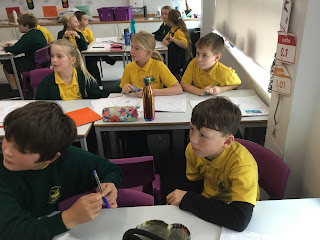
 Imagine you walk into a classroom and you are asked to pick up a success criteria and take off one of your shoes. Well this was the first instruction for year 6 today. The children were then asked to draw around there foot and to think about all of the activities they have carried out this morning both at home and at school that would of used a type of energy.  We then looked at the impact both man and natural factors have on the amount of Carbon Dioxide created.  This is what the children came up with. 
French: lesson 3: map of the world

Image
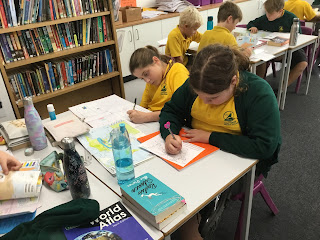
 Year 6 learnt the names of the continents, oceans and some rivers in French. They listened to a song, to tune in, listening out for names that they recognised as they are so close to the English. They then used an atlas to help them label the continents and oceans and for a challenge, find he rivers, draw them in the correct place and label them.

French: lesson 2: Countries and languages spoken there

Image
 Year 6 continued with  looking at the names of countries in Europe and the languages spoken there. They also found out about a Francophone countries. They has a conversation with their partner, asking  them their names, what language they spoke and where they lived. They then wrote some paragraphs, using given sentence structures. 

Science - What is reflection?

Image
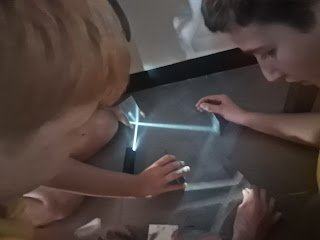
 Obviously, we already know what reflection is - based on our experiences in everyday life, and our learning from Year 3. However, today we learned the Law of Reflection, and used this to create a range of shapes with mirrors; from squares, stars, triangles - even creating our own mirror mazes.  The children had great fun lining up the mirror and light ray to ensure that their angle of incidence was correct, so that the reflected light ray would hit their desired end point. Next week we will be exploring the Law of Refraction, and we will try to do the same thing - but the mirrors will be removed, and we will have to use our knowledge of materials densities to bend light accurately! 
Image
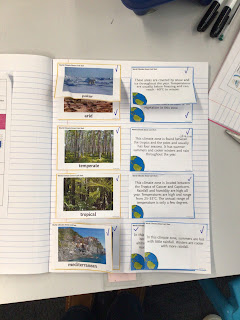
This week, the children were given a picture, definition and climate graph. Using their locational knowledge as well as their understanding of climates and different biomes they had to find the correct combination. Most found matching the picture to the definition quite easy but using a climate graph which only discusses the temperature and rainfall a bit tricky. However, after a class discussion the children debated which climate graph would match their definitions. Do you think you could match these graph up?

Maths- fractions

Image
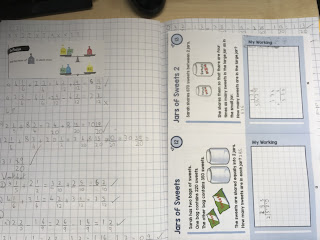
 Learning objectives: I can add and subtract fractions that have whole numbers  This week the children have been applying their knowledge and skill learnt the previous week to more complex questions regarding adding and subtracting fractions. It is clear that the children have worked incredibly hard to embed their knowledge and understanding of this topic.  On Monday, the children looked at two differing techniques to work out how to subtract a fraction from a mixed number. Firstly, we looked at taking the fraction away from the whole number and then adding up what is left over. Secondly, the children converted the denominators of both fractions and then proceeded to do the subtraction. You can see both methods in the pictures below.  The children then did a further lesson to embed their knowledge, which they aced. They know move on to multiplying fractions by fractions and integers.